Cutting Through the BS of Corporate Video! Episode 6 | Embrace – The Operating Layer for Media
Here we are again with Episode 6 in our series on “Cutting Through the BS of Corporate Video“!
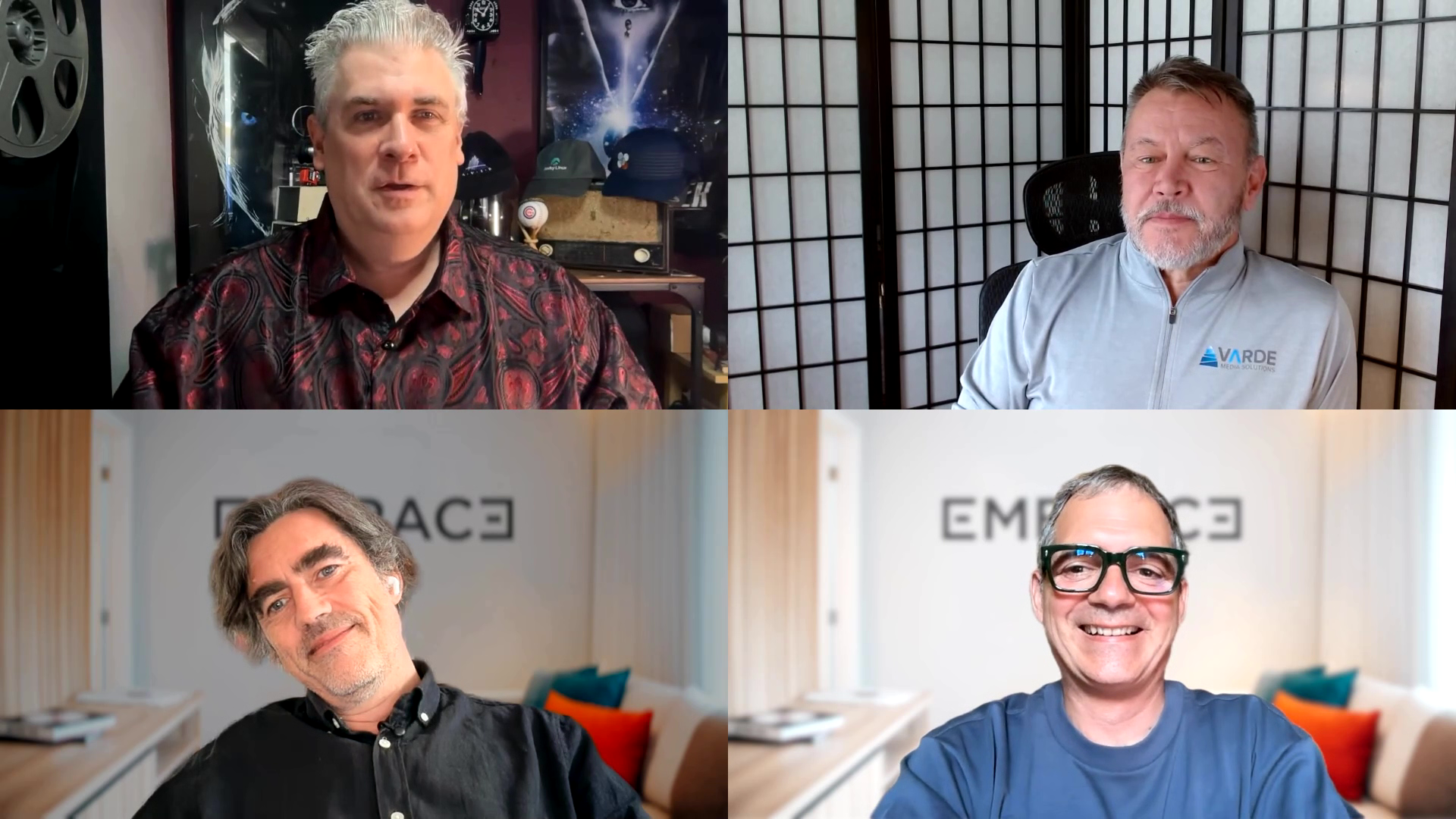
In this episode, Jeff Sengpiehl, The Post Doctor, and I go underneath the tools to the layer that runs the whole thing. Our guests are Emmanuel Pain and Johan Bergström from Embrace, who call their platform the operating layer for media. We dig into what an operating layer for enterprise media actually does inside an Enterprise Video Content Factory: orchestration versus automation, why generic workflow engines fall over on video, why there is a human checkpoint by design, and how brand guidelines, localization, and personalized video get industrialized without losing control.
Watch the episode here (don’t forget to share, like, subscribe, etc.!):
Join the discussion on Varde’s LinkedIn page and stay tuned for the upcoming episodes where we also bring in manufacturers and end-customers!
Takeaways
- An operating layer for enterprise media is not a pipe between systems. It carries the business process, so the organization can ask whether a given flow is worth running at all, while it is running.
- Automation acts on one instrument. Orchestration runs the whole business process across systems, services, and the people who own the decisions inside it.
- Generic workflow engines struggle with video. Heavy files, format complexity, versioning, subtitling, and media-aware user interfaces are the reason a media-centric platform exists.
- Human checkpoints are a design choice, not a gap left over from a manual process. The tool does not decide who owns the checkpoint. It makes sure the checkpoint exists and is auditable.
- Most corporate deployments start by getting more out of systems already bought, often used at a fraction of their capacity, rather than replacing them.
- Without mechanisms that track time and budget against output, video is an expense with no measurable return.
- Brand governance at scale comes from templating plus data. Templates carry the guidelines, data fills them, and that combination is what makes localization and personalization repeatable across territories.
- Localization is a compliance problem as much as a language problem, and automating it with AI services without an orchestration layer is how control gets lost.
Full transcript
Lightly edited for readability. Filler words and false starts removed.
Introductions (0:07)
Jeff Sengpiehl: Previously, Eivind and I argued that corporate video is really a content factory, a media supply chain, and that the hard part is no longer the tools. It’s ownership, process, and how everything connects. That’s really easy to say when the folks who sell those tools are not in the room. Today, we’re going to go underneath, to the layer that runs the whole thing. Embrace calls itself the operating layer for media. They make two products: Pulse-IT, which orchestrates the workflows, and Automate-IT, which industrializes promo and graphics generation. We’re going to spend most of our time on Pulse-IT, because orchestration and integration is exactly the connective tissue our content factory has been missing on the show so far.
Eivind Sandstrand: It doesn’t take long for a given business operation to become not only critical but complex: something the business depends on, involving people and systems all over. The same can quickly become the case for a content factory. In a corporation, enterprise video isn’t the business itself, but it will invariably stem from, move within, and touch upon a myriad of departments, systems, policies, and procedures. The challenge is that in order to safely and securely orchestrate and automate these tasks, and the data that flows between these nodes, if we can call them that, you need a business process management component. This is what Pulse-IT can provide, for instance. So with that, let me introduce our two guests from Embrace. We have with us Emmanuel Pain and Johan Bergström. Emmanuel, why don’t you lead us off and give us a quick intro of yourself.
Emmanuel Pain: Thank you so much for having us today. Delighted to talk about this important subject, and to be honest, one that is not really touched upon in the corporate world. I’m Emmanuel Pain, business development manager at Embrace. I’ve been in the media and entertainment industry for more than 25 years. I started my career in the live streaming world, then moved into post-production environments and services companies. I’ve been with multiple services companies, as well as a lot of startups and grown-up companies in the SaaS world, and I’ve been at Embrace for almost three and a half years. My role encompasses channel management, product marketing, and tech alliances.
Johan Bergström: I’m Johan Bergström, a Swede, now working as a fractional CMO helping Embrace with their marketing efforts. Just like Emmanuel mentioned, we have been working a lot on product marketing, but also on the positioning of who we are and what we want to talk about.
What an operating layer for enterprise media actually means (3:01)
Eivind: Before we get into either of these two products, I’d love it if you could give our audience a frame, in your own words, answering this question: what does “the operating layer for media” actually mean to someone who does not live in broadcast lingo, meaning our friends in the enterprise world?
Johan: I think you used the word media factory or something like that.
Eivind: We call it the enterprise video content factory.
The operating layer is not so much about the flow of content going from A to B. It is about understanding whether it is even relevant to make that flow.
Johan Bergström, Embrace
Johan: There we go. Thank you. In the media industry, there’s been a lot of talk about orchestration, automation, or even media supply chain, which has been the buzz for maybe ten years now. We see that the operating layer is not so much about the flow of content going from A to B, or the connections in between, but about understanding whether it is even relevant to make that flow. You have the business goggles on to understand: are we even doing the right thing? Embrace, through its products, can provide that layer of visibility and understanding of the business, not only connecting the pipes.
Orchestration, automation, and inclusion (4:22)
Jeff: So let’s start with the plain definition. Pulse-IT, as described, is the orchestration backbone of that media supply chain you just mentioned, or the video content factory. For someone who’s never run one, what is orchestration, how is it different from automation, and what’s broken without it? What problem do you solve?
Emmanuel: For an orchestra, you need a conductor, and you need a lot of instruments. Pulse-IT, by definition, being that operating layer, has multiple functions. One of them is to be an orchestration layer: to control, and to provide visibility and understanding of how all the other instruments are playing. When you talk about automation, you have a lot of automation around each instrument, if you wish. Typically: I need to move a file from point A to point B, or automatically launch, on a schedule, a process around a transcoding engine, a media asset management system, or a graphics tool. Orchestration implements a business process all the way through, managing all your different instruments. The instruments in that analogy are software, systems, or services, and by services I mean cloud services, AI services, on-prem applications, bespoke applications.
But software, applications, systems, and technologies are one element. There is something really critical that we have been integrating since the inception of the company, which we call inclusion. At the end of the day, in a corporate environment, the most important asset of any corporation is its people, and having people as central stakeholders in how the business is run is essential. With an orchestrator, you can combine the goals and roles of every colleague, every human being in an organization, with all the tooling at their disposal in the information system, to achieve a business goal. You help them implement business processes that make them aware of what is going on, give them visibility, and help them in their day-to-day tasks, so they can focus on value-added work instead of repetitive work. It’s all about connecting the technologies and connecting the people to achieve a business goal.
Eivind: Jeff and I have said that the corporate version of this problem has more handoffs between people who do not think of themselves as media people. You work with broadcasters and streamers, and you do this at scale. Among your toughest customers, what do they have in common, and what do they tend to get wrong when they first try to figure this out?
Emmanuel: Large enterprises are now becoming their own media. They have their own content, their own target audiences, and multiple geographies to cover. They need to manage compliance, legal aspects, you name it. Video as a medium has taken on so much importance that you see a lot of similarities with traditional media and entertainment. What are the key aspects? Number one, the number of destinations. We used to have linear TV, then nonlinear. Then the number of geographies. Compliance, as I mentioned, is very important. Managing rights, meaning all the different aspects of distribution, is very important too. We started to see in the corporate world much more need for automating and streamlining those processes, and for orchestrating across multiple options depending on the reality of the marketing campaigns and the needs of the communication plans. They need to adapt to multiple scenarios at the same time, and, as you said, with people who were not trained to work on video in the first place. Video is critical for all these corporations, but they don’t have the staff, and the staff is not trained the same way. Yet they need to achieve results similar to media and entertainment companies.
Why video breaks a generic workflow engine (10:02)
Eivind: One quick follow-up on that. For the non-technical, non-media people out there: what is it about video that makes this so inherently different or difficult that you shouldn’t just use any business process automation tool? You’re the operating layer for media specifically. What’s different?
Emmanuel: Video itself is complex. Shooting is complex. The files are heavy. The technical formats are complex. It’s complex to produce and to post-produce. It’s complex to make that content accessible and available in multiple languages, managing subtitles. Everything around content preparation is complex with video. So a typical orchestration layer or a simple workflow engine cannot cope with the nature of the job. That is why you need very specific capabilities in the platform to tackle these challenges.
Johan: It is a very versatile format, which has inherent qualities that mean you really can’t use a standard orchestration platform. There are many out there. You would run into issues quite fast if you used them. Basic things like ingest, and making versions of the same video, are going to be very difficult if you’re not using a media-centric platform like Pulse-IT.
Emmanuel: Most importantly, the UI and user experience will be in context. We haven’t talked a lot yet, Jeff, about data and the data-driven automation behind it, but everything is linked. When an event happens in the information system, it can trigger a workflow or a notification. A simple example of being media-centric is that we provide what we call a media selector in our web forms, to browse any type of storage. I need to pick a media file to send it to a colleague or to another system, or I don’t even need to know where it’s going. I just know I need to pick that file, or a couple of video files, review them quickly, and continue the flow. That is the type of user experience that is required. It sounds simple when you explain it like this, but having those capabilities built in and natively integrated into the software, and I could go on with dozens of examples like this, on both the technical workflow engine and the web forms, UI, and UX, is what makes the real difference between Pulse-IT and other tools out there.
Jeff: I think one of the other things that comes to the table is that there’s a certain cachet with video. You can look at it and say, “My messaging is entirely correct, but my voice doesn’t sound like it should.” Or, “I was wearing my glasses. I don’t want to look like that on camera.” So there’s a different level of approval and authentication, and of what people want out of the system, rather than just making sure the slide deck has the correct bullet points.
Human in the loop by design (14:06)
Jeff: The other thing I want to call out is a design choice inside Pulse-IT. Let’s make it explicit: there’s a human in the loop by design, rather than fully agentic automation. Why build deliberate human checkpoints into an orchestration engine, and where do they sit?
It’s not about distrust. It is about adding value.
Johan Bergström, Embrace
Johan: The term we use internally, which has been mentioned before, is inclusion. We’re not retrofitting this with humans. It’s always been there. The system, the business ambitions, and the individuals in this environment are all interlinked. It actually needs a human to add a layer of understanding to the flow of information, and of course this is designed by the company itself. Most of the time, companies aren’t ready to do that. I need to add metadata. I need to do this. I need to take off the glasses. So it’s not about distrust. It is about adding value.
Eivind: It’s the ownership and process argument from our earlier discussions made concrete. The tool doesn’t decide who owns the checkpoint. It makes sure the checkpoint exists and is auditable.
Emmanuel: And especially in a corporate environment, when you have 10,000, 20,000, or 100,000 employees and worldwide operations, you need to create links between all the different stakeholders. That means: I want to bridge legal with marketing in US East, I want my colleagues in Europe, out of London, to be aware of this at the same time, maybe I want a compliance check on it, and I want the people in charge of branding to be alerted at a specific moment. And this is maybe the most important aspect. You asked me earlier what some customers are missing: it’s taking the time at the beginning of the project to sit down and ask, what is it I want to implement, what is my goal? Once that exercise is done, you have a successful project.
Eivind: Take the time up front.
Emmanuel: Yes.
What it looks like day to day (16:44)
Eivind: Say a customer already has a MAM system, some cloud storage, on-premises storage, a QC engine, a transcoder, and an editor. What will it actually look like, from start to finish, as you connect these through a tool like Pulse-IT, for the people running it day to day?
Emmanuel: For an operator, someone who has access to the system, they log in to a personalized workspace. The point is that a user sees the right information at the right moment, in the right context, and Pulse-IT gives you that. With all these different components, you want the plumbing completely hidden, so that different operators, depending on their role and rights in the system, see exactly what they need to see. That, in a nutshell, is the user experience we provide.
For a standard user, it means simplifying the day-to-day processes so they can focus on the job to be done. That is really key. For other roles, it gives you everything we mentioned around visibility and control, and that visibility and control is not only about what is happening on the different systems. Since Pulse-IT is the horizontal layer plugged into all those systems, services, and applications, I can retrieve their status and health. Depending on the stakeholder, from an operations perspective, I can see costs, I can control things, and I can operate my environment toward my business goal. You can go in baby steps until you have that operating layer giving you granularity and visibility into everything that is happening.
That’s the difference between a factory that waits to be told what to do and a factory that responds.
Jeff Sengpiehl
Jeff: I think that’s the difference between a factory that waits to be told what to do and a factory that responds. In real content operations, you usually don’t have someone sitting there waiting to press the start button. The request shows up, the new asset shows up, and then it’s an approval step. The reason this matters for corporate video is that the systems we’re talking about connecting were never bought to work together. They weren’t bought at the same time. They were bought with different budgets. Marketing got one thing, IT got something else, the agency brought in a third. This connective layer is what turns that into one operation. It’s a concept I’ve been talking about for a few years called digital cartilage. The bones are there. You need something to cushion them so they don’t rub up against each other.
Making the best of what you already have (19:44)
Emmanuel: A very important aspect of that, Jeff, is return on investment. You will always have someone who says, “Look, we have a business to run. Video is cool, but it’s not our primary business. Do the best you can with what we already have.” And sometimes you realize that all the software, hardware, applications, and SaaS services bought every day by multiple departments on multiple credit cards are not controlled, are barely used, or are used at maybe 10% of capacity, and we keep adding layers and layers. What we found is that a lot of our customers implement Pulse-IT to make the best of what they already have, and that is already an important step, because they also sometimes have their own bespoke applications in house. In media and entertainment, we talk a lot about traffic systems or work order management. You have similar applications in the corporate world: a custom-built CRM, another type of work order system, or a financial reconciliation system you need to connect to. We have success stories around making the best of what customers already have and making it easier for users on a daily basis, so they can meet management’s expectations on throughput and the volume of content to be pushed out, and make sure their customer experience with video is at its best. Since we can do that, implementing innovation is easy, because you can run proofs of concept, adding pieces along the way. That is the capability Pulse-IT provides.
Jeff: And I think this also speaks to the other KPIs. For broadcast and video people, it’s: how many eyeballs did I get? Let’s pull the analytics, see how many people watched and when. In a corporation, this could be a discussion about whether we’ve reduced the number of support calls coming in. What is our customer satisfaction level? Are we bringing new customers in the door? Completely different sets of metrics that aren’t video-related, but they’re impacted by what is done in the video content factory, positively or, hopefully not, negatively. That can happen too.
Eivind: Rather than just describe it, let’s put a picture to it. I understand you have a few slides or a short demo clip that walks through this.
[23:01 to 25:09: Embrace case study clip, TF1. Original audio is in French with embedded English captions.]
ROI, measurement, and orchestration across the content factory (25:20)
Eivind: Thank you for showing us that. What I’d like viewers to notice is that in the TF1 case study, nothing there replaced an old tool. Every system involved in that media supply chain is something they already had, but now they are able to put it into a process, an organism, that becomes the operating layer.
Without that, you just have an expense. You don’t have an ROI.
Eivind Sandstrand
Before I move on to corporate use cases, I want to pick up one thing you said, Emmanuel, about ROI and measurement. A business’s ability to measure what it does is not just dependent on owning the output, a video file. You have to have mechanisms in place to track it and capture the time spent, the budget allocated, and so on. Without that, you just have an expense. You don’t have an ROI. That is one of the most important things missing in most media supply chain operations today, and it should be an integral part of the content factory.
You mentioned to us earlier four use cases that map well onto what Jeff and I have been calling the content factory: orchestration across the factory itself, managing brand guidelines, localization, and personalized video for customer engagement and loyalty. Let’s take them in turn, starting with orchestration across the content factory. What changes for a corporate team when this operating layer goes in?
Johan: It goes back to something I think you said before, Eivind. It’s not only about the outcome you see. It’s also about making decisions while it’s running. You can fine-tune your work, and also understand whether a cost is really relevant to your ultimate business need. That is one thing that will change, and it may require some thinking, because all of a sudden you can ask: is this the most optimal way to run this? A lot of times, looking at business processes, you end up with a result and say, “That was expensive,” but you already have the invoice.
Emmanuel: This is also about quality content: good branding, good stories. That is the goal. When you’re making all those videos, you want them to be amazing. You want a fantastic graphic layout, the best effects, the best storytelling. You want to free up your time and your ability to do things. So: freeing up resources, making the most of what you already have, and giving you more flexibility and freedom. I think this is what our solution brings.
Brand guidelines at scale (28:51)
Jeff: One of the other things you brought up is brand guidelines. Doing that at scale is something every corporation, and even small companies, struggle with. The more people who can get messages out, the harder it is to keep them on brand. I’ve been on the other side of that: “That’s not the right logo. Can you pull that down and run it through marketing before you post?” How does orchestration keep the brand consistent without slowing the process down?
Emmanuel: We have another product, Automate-IT, that gives you the ability to work with Adobe After Effects templates. Because you have templates and brand guidelines, you can ensure brand consistency. That is a really important aspect. On top of the template, add the ability to use any type of data, wherever it sits and in whatever format, from XML to CSV to Excel to a live database with live data coming in. You can tap into that data and inject it into the template. You can also add different audio and different video. All of a sudden, you can add to your content factory what we call generated graphics videos. This is not for live graphics, but for everything that can be rendered, and Adobe After Effects is the tool of choice for that in corporations and agencies worldwide. Once you control the brand guidelines per territory, per brand, per campaign, and so on, you are in a position to do personalization at scale. We’ll get back to personalization, but brand guidelines matter a great deal, thanks to templating and the industrialization of templating.
Johan: And this is running at major corporations today, as well as at broadcasters. In that regard, there is no difference.
The tool enforces what the brand owner defines, and it keeps a record, so everybody is marching to the same drummer.
Jeff Sengpiehl
Jeff: I think it gets back to the ownership question our previous episodes have talked about. Someone has to own the standard. They’re not necessarily the person who created the thing they want to get out, and the tool doesn’t own it either. The tool enforces what the brand owner defines, and it keeps a record, so everybody is marching to the same drummer.
Emmanuel: Exactly. And in the way you implement that, you also need to look at volume. If you talk about templates and industrialization, you need the volume to justify orchestration, to go back to point one. If you are doing one white-glove campaign, maybe you don’t need automation, and that is perfectly fine. You will have the right stakeholders managing the brand guidelines. But if you need multiple versions across 50, 60, or 70 territories, that is where automation and industrialization are really important, to make sure you don’t have errors, and that compliance, governance, security, marketing, and layouts are all taken into account.
Localization is a compliance problem (32:37)
Eivind: Let’s take corporate use case number three, since you mentioned multiple territories: localization. For a large global brand, this is an enormous challenge, with a lot of hidden manual work. In a content factory with an automation and orchestration tool, how does the approach to localization change?
Johan: Localization is often also compliance, as we mentioned: rules that say we can’t show this in a given region. That has always been done. What companies are trying to do now is make it more automated. But when you do that, especially with all the AI services available now, it’s very easy to lose control. You can add auto-transcription, voice-over, even lip syncing in different languages, and that process can run for every product you make. With Pulse-IT, you can orchestrate and control it.
Jeff: Another problem that pops up is that people think of localization as making sure the visuals and audio are in the target language, without realizing there are cultural and religious considerations you have to comply with. Otherwise you take a hit on your return on investment. People get upset. It causes all sorts of unpleasantness you really don’t want to get into.
Emmanuel: Exactly. And as a corporation, you want to protect your brand, whether you have one, ten, dozens, or sometimes hundreds of brands to manage across the board. Think about the scale of all the assets that need to be managed, created, localized, and distributed. Localization also means the right distribution to the right destination. If a piece of content is in its original language and I don’t understand any of it, it’s useless. All these aspects need to be looked at.
Jeff: And the last thing a brand wants is to be seen as tone-deaf.
Personalized video, data, and customer engagement (35:15)
Eivind: There are cases where tone-deafness is the least of the problems. The worst case is jail time. There are really grave impacts that can happen. Let’s get into something very strategic: personalized video to support customer engagement and loyalty. This is where video stops being broadcast communication and becomes an integral part of the customer relationship. What does that look like for you, and what makes it hard for everyone else?
Johan: It goes back to a couple of things we’ve said: the ability to make strongly branded content, using a tool like Automate-IT, and making sure the data you as a company own on a person is used to tailor that experience, whether it’s my favorite color as a banner or some other piece of information. And if you can’t use that data, it’s useless. But if you can use it in the content factory, it’s gold.
Emmanuel: The more you can offer that kind of unique experience throughout the customer journey, using video and all the formats associated with video, the more it drives engagement. That is really important. It’s still complex. You mentioned loyalty programs. We’ve seen that in many industries, and one example is the automotive industry, where we provide personalized video at scale for specific brands, including outside of loyalty programs. Companies with the right information systems and a clear goal for the experience they want to give customers can expand step by step into personalization, and we see more and more of that. It’s also linked to what we’ve seen in recent years around user-generated content, which can feed into personalized videos, and all of this starts to be combined. We often see marketing and communication agencies helping large corporations with these programs. It’s here, and today a lot of videos are generated for these programs on a daily basis.
None of them get fixed in an editing bay. Every one is an orchestration and data problem dressed up in a video costume.
Jeff Sengpiehl
Jeff: And personalized videos lead to influence, influence leads to going viral, and at that point it’s free marketing exposure: a very small investment gives you a huge return. The thing common across all the problems we’ve talked about is that none of them get fixed in an editing bay. Every one is an orchestration and data problem dressed up in a video costume. That’s the whole concept of our series in this one segment.
Emmanuel: You mentioned a key word again: data. You need the data, and you need clearance on the data. You need the right programs and framework around it, and the system needs to be in place. The data layer, the data foundation, is critical to delivering that user experience, because the data is what makes it personalized. At the same time, the template is what enables industrialization. You need the brand guidelines and the templating to deliver something governed across territories and marketing segments, and you need the data to fill in the template and create that unique, specific engagement. And this goes back to ROI, because the core of the video may be the same for every user, but the data added on top, or as an opener or closer, makes a world of difference in engagement.
Jeff: That’s something a broadcaster is not going to be concerned about. They’re not interested in tying the NBA Finals into Salesforce to pull in all this other information. This is a core corporate concept.
Wrap-up (40:18)
Jeff: That’s a sentence from our first episode made real: produce one asset, one template, and serve every audience, every language, every format. The savings aren’t in making the video. They’re in not making a hundred more of them by hand.
Across all our discussions, the picture has been filling in. We said corporate video is a business problem that happens to involve media. Today, we saw the layer that runs the whole factory and connects all its parts. We’ll look at the editing layer in later episodes. The tools keep getting better, which keeps raising the stakes on the parts that were always hard: who owns the process, where the human checkpoint sits, and how it all connects.
Eivind: And as always when humans are involved, the tools and processes are going to change, often and forever. If your organization is like most, IT doesn’t really have the time or skills to develop custom integrations between all these nodes, systems, people, and processes every quarter or so. The answer lies in the no-code and low-code approach of tools like Pulse-IT and Automate-IT, giving you the ability to adapt and evolve quickly, prototype, test, and innovate, as Emmanuel said, and to build out AI-enabled capabilities in a safe and compliant manner.
Johan, Emmanuel, thanks for joining us today. Where should people go to learn more about this, or see it in their own operation, other than talking to Varde?
Emmanuel: We have a great website, embrace.fr. That’s a good point of entry, and it has the contact details for Johan, myself, and the rest of the team. And at the trade shows for the media and entertainment industry and the corporate video industry, we’re there, either with our own booth or with Varde. We’d be very happy to meet you at any of those shows going forward.
Jeff: Sounds perfect, gentlemen. Thanks for joining us today. Next time, we’re going to dig into other parts of this content factory. And if you’re an equipment vendor who’s also cutting through the BS, drop us a line. As always, please hit the like and subscribe buttons. It helps us bring this content to you and reach the right audience. Our contact information is below, so you can get hold of Eivind or me to discuss anything that’s bothering you about your needs for a video content factory. We look forward to seeing you on the next episode. Thanks, everyone.