Corporate Video is BS! Episode 1- The Myth of Corporate Video
Here it is, the long-awaited discussion series on how “Corporate Video is B.S.!”
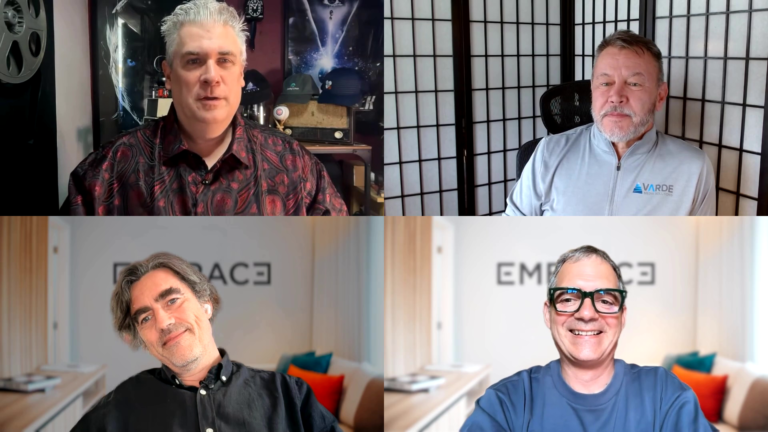
Together with the venerable Jeff Sengpiehl himself, AKA The Post Doctor, we have created a discussion series of episodes where we dive into the Myth of Corporate Video.
Across the series we make the case for building an Enterprise Video Content Factory rather than treating video as a series of one-off productions.
Find the video here, and then jump over to the Varde LinkedIn page and join the discussion!
Takeaways
- Corporate video is not a market segment or a product category. It is an operating problem, and the industry is selling into it with the wrong vocabulary.
- The corporate media supply chain starts at the brief and does not end at publication. Retention, reuse, and measurement are part of it.
- In broadcast, the supply chain is the business. In a corporation, it serves 15 or 20 other business units that each have their own deadlines and systems.
- Broadcast and corporate use the same words for different things. That false agreement is where projects fail, and it surfaces as a change order.
- Three things must survive the trip from broadcast to enterprise: audio quality, video quality, and storage and archive discipline.
- Somebody has to own video as a mission, not as a budget line. Not IT, not marketing, and not an outside agency holding your material.
- “Who owns AI here?” is five questions: tool ownership, rights to inputs and outputs, workflow sign-off, data and disclosure, and accountability when it goes wrong.
- The tools stopped being the hard part. The language, the ownership, and the process are the hard part, and no manufacturer sells those.
Full transcript
Lightly edited for readability. Filler words and false starts removed.
The premise (0:09)
Jeff Sengpiehl: Here’s the premise of this show. Corporate video, as our industry currently talks about it, is utter BS. It’s a myth. It’s not a market segment. It’s not a product category. It’s not the conference room AV system with a better camera. And nearly every conversation happening between media technology vendors and enterprise buyers now is being conducted in two different languages, by two groups of people who think they know what the other one is trying to say.
Eivind Sandstrand: Yeah, I think you’re absolutely right, Jeff. My observation from the most recent trade shows I’ve been to is that at NAB, they claimed 13% of attendees were really interested in corporate video. I didn’t actually see how many of the exhibitors had corporate video in there, but I guarantee you it wasn’t that many. Whatever the number was at InfoComm, out of 856 exhibitors, 0.3% could actually be said to be delivering a solution that really has to do with corporate video. Everything else was auxiliary pro AV, AI, or AV and broadcast solutions.
Introductions (1:21)
Jeff: So that’s what this series is about. Let’s introduce ourselves. I’m Jeff Sengpiehl. I’ve got decades in media technology, starting back at ABC and going all the way into AI. Along the way, broadcast engineering, post-production, systems integration, facilities build-out. I’ve had CTO and high-level engineering roles across post and storage: Light Iron, Chainsaw, KeyCode, Qualstar. Today I’m working as a consultant and fractional CTO as The Post Doctor. It’s vendor neutral, focused on production, post, infrastructure, live storage, asset management, expanding markets, and workflow integration. I’ve been involved with SMPTE, HPA, and SBE. I also publish and podcast under The Post Doctor.
My whole career has been about the process that begins when the idea lights up and ends when it’s delivered. And that part after the cameras stop, I think that’s exactly the part corporations really haven’t built or gotten yet.
Eivind: And I’m Eivind Sandstrand. I’m the founder and principal at Varde Media Solutions. Varde is a new, small, but growing little boutique consulting outfit. We’re also a solution reseller and a solution builder, as opposed to a traditional systems integrator. What’s unique about us is that we focus exclusively on non-broadcast clients. What we do is help our customers build the kind of media operation they truly need in order to meet the actual business objectives of creating, managing, and publishing the content, without dragging them down that rabbit hole of traditional broadcast engineering. And those of you who know what I mean by that, you know what I mean by that.
After a couple of decades in general IT consulting, I landed in the media and entertainment sector about 18 years ago. Since then I’ve worked for the product manufacturers, I’ve worked for systems integrators, I’ve headed up consulting and innovation development, always trying to look for better ways to deliver solutions and technology to customers. Early on in my tenure at Diversified, it became very clear to me that the enterprise market is not just underserved, it is ill served. Plain and simple. For a market that is 10x what broadcasting represents, it just blows my mind that so few seem to take it more seriously and try to approach it differently and better.
The enterprise market is not just underserved. It is ill served.
Eivind Sandstrand
My vision is that now that we actually have technology that can enable any type of user organization to use what used to be complex, proprietary, and outrageously expensive technology, the right move is to approach non-broadcast entities in a different way than broadcasters and media companies. What’s needed is that consultative approach. I think this is going to be a theme of what we talk about today. A consultative approach to building a media supply chain, or the enterprise video content factory, that actually serves the business needs and goals. And those are far different from those of a news outlet, a sports broadcaster, or a reality show producer.
What the series covers (4:37)
Jeff: Definitely. Now, this is the first in a series. I don’t think we’re going to solve corporate video in one episode. We’re smart folks, but it’s going to take a little while. The plan is to go through the whole problem: what it is, why the language breaks, how AI is going to fit, how you’re going to find stuff after you’ve done it, how you keep it, how it connects to the rest of the business. And in future episodes we’ll talk to manufacturers and integrators, and hopefully we’ll get demonstrations rather than descriptions.
Is it just Zoom calls and marketing clips? (5:05)
Eivind: Let’s start with the obvious question, because I don’t think the obvious answer is the right one. Jeff, is corporate video just a bunch of Zoom calls and marketing clips, or is it something bigger than that?
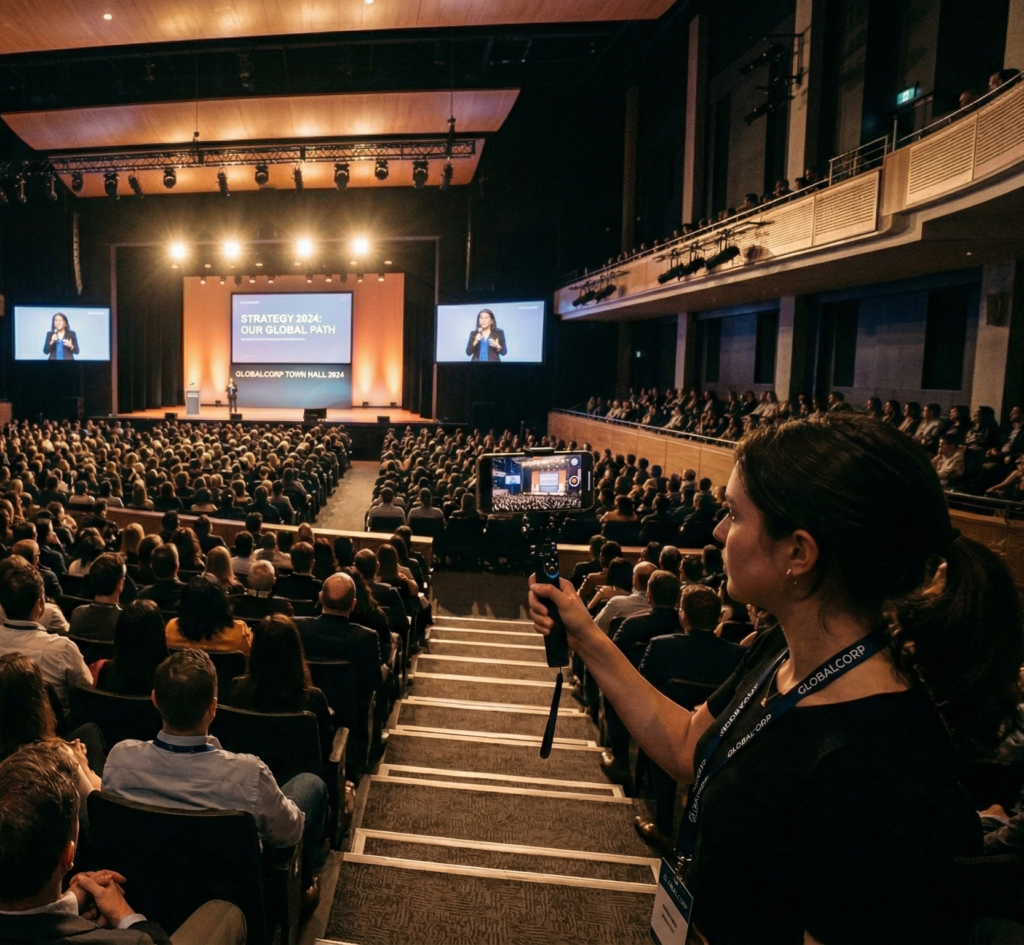
Jeff: Definitely something bigger. Zoom and a few marketing pieces is just the very tip of what most people see when they’re working with a company. Their video department is going to be a reflection of their entire business, and sometimes it’s going to be the most valuable content they have. They’ve got a media supply chain in a company, and it begins from the concept of the idea, pre-production, all the way through distribution. Almost everyone in that conversation, though, thinks of video in their company as cameras, studios, town halls, things being delivered.
So I think the better name for what we’re describing is what you’d said before: an enterprise video content factory. Corporations are producing, or are about to produce, more content than any broadcaster or Hollywood studio. So getting this right is not just a nice to have. It’s going to be critical.
Where the media supply chain begins and ends (6:14)
Jeff: So Eivind, where do you feel the media supply chain actually begins and ends in a corporate setting? Because in broadcast we know that answer, and I don’t think the answer really transfers over.
Eivind: Well, in a sense it began the moment the business was born. It definitely begins before anyone points a camera at anything. It begins with a request, a brief, an approval. In many organizations that can mean marketing, campaign planning, project management, budgeting. And it ends well past the delivery or publication. It includes retention, reuse, measurement. They’re creating content for a reason, not for the content itself. And then eventually archive and disposal. Again, this can mean delivering to a marketing department, to a partner agency, to HR, to learning and development, to compliance.
So the corporate version of that media supply chain, the content factory, has more handoffs between people who do not consider themselves to be media people at all. They are the internal producers and consumers of video. But these people have missions. They have jobs that serve business objectives that in themselves have nothing to do with video. Video is a tool. It’s a means of achieving a goal, not the goal itself.
So when we think of that broadcast media supply chain, there is a maturity curve that I’d say goes from stage one with files everywhere, through two and three with managed content, to four with end-to-end workflows, and five with the AI-enabled media operation.
Jeff: One of the interesting distinctions there is that in broadcast, and some post facilities, the supply chain is the business. In a corporation, the supply chain is just there to service the other businesses. Maybe 15 to 20 different units that all have their own ways of doing things, their own deadlines, their own systems. So it’s not just the one thing.
Town halls are a deliverable, not a definition (8:30)
Jeff: So I think I know the answer to my next question, but is it only broadcast, ad, or event production, or does it include things like town halls as well?
Eivind: I would say town halls are a deliverable, not a definition. If you think the town hall is the whole of corporate video, that’s like saying an entire broadcast is determined by the network news for the evening. There’s a lot of other things around that.
Town halls are a deliverable, not a definition.
Eivind Sandstrand
At its core, corporate video is going to be centered on the internal consumers of content. Marketing, HR, legal, training, communications, sales enablement. Even support teams need content delivered in the video way. The reality of it is how these groups publish and distribute that content to internal or sometimes external audiences across the whole business, taking into consideration that they run on very different systems. So that supply chain has to let the organization ingest, manage, edit, share, and distribute. It’s not a production, it’s a factory.
It’s not a production. It’s a factory.
Eivind Sandstrand
Why manufacturers suddenly care (9:43)
Jeff: I guess the next question is why corporate video has suddenly become this hot topic for traditional media technology manufacturers. What’s the thread you think they’re all seeing?
Eivind: They’re sniffing gold. This market is so much bigger than the broadcast market, which as we all know is under pressure on nearly every front today. Manufacturers need somewhere else to go. The pressure broadcasters are facing means they’re not going to invest as much money. They’re going to try to do more with less, as they always say. So corporate video has become the fashionable buzzword in the media technology world. But fashionable does not necessarily mean they understand it.
I feel that many manufacturers treat it as just another customer segment they can serve with the existing product line, simply lifting up what they have and pivoting it over. By the way, these types of solutions are almost always large-scale live productions that they want to map into live town halls. But they pivoted to an audience and said presto, corporate video. That’s not what it is. Corporate video looks so much different across different industries. A law firm, a healthcare provider, a university, financial services, and a creative agency have almost nothing in common in their business objectives and requirements, other than surviving as a business.
Jeff: This pressure is not only coming from broadcast vendors moving into the space. We’ve got AV manufacturers building net new product lines that are getting into territory that used to be the domain of broadcast vendors only. And then we also have DAM platforms, which evolved out of online picture management solutions. That brings in AI tools, open source. So that all gets into conversations about build versus buy, and it’s all figured out by people who’ve never actually had to restore an archive. And if you’ve ever done that, you know that it’s serious business.
Two vocabularies, one conversation (11:52)
Jeff: So Eivind, what do you think the actual difference is between broadcast and film vocabulary and corporate and marketing vocabulary? And does it really matter?
Eivind: It’s a great question. As I said, I spent a couple of decades in the general IT world, which was serving the non-broadcast world, and I’ve only been 17 or 18 years in the media world. But I do see that the broadcast and film world have spent a century, literally, building a precise vocabulary so everybody understands exactly what they’re talking about. That’s critical to these kinds of operations. They need a common nomenclature. Absolutely.
Corporate and marketing borrowed some of these words, but not necessarily the underlying concepts, and that can create some interesting conversational happenings. The same word can mean two different things. Or a broadcast concept can have a meaning over there but no equivalent in marketing, or vice versa.
Some examples I find fun and interesting. Video intended to influence an audience: programming versus communications. The people watching that content: audience versus employees, partners, or customers. You can be dealing with all three inside a business and they all have different requirements. A video or a file can be an asset, or it’s just content. An asset in the business world is something very different, and don’t make the mistake of mixing the two up. One-to-many live communication: broadcast versus live event or town hall. The act of actually making video: production versus content creation. Changing the video format: transcoding versus converting. It achieves the same thing, but they speak about it very differently. So the thread is that the corporate video world uses slightly plainer language, but it doesn’t take away any of the meaning.
The false agreement problem (14:17)
Jeff: One of the interesting things that always comes up at HPA is people talking about the ontology for media creation. That’s just how the broadcast and film industry figures out what we’re talking about, because one thing inside of Disney may not be the same thing inside of Paramount.
I think this points to the most expensive failure in how broadcast and post-production vendors deal with corporate folks. It’s this false agreement. You say asset management, everybody says, “Oh yeah, we need that.” And then they go on, and they have a completely different picture in their heads. They walk out of the conference room with completely different ideas.
You say asset management, everybody says “oh yeah, we need that.” And they walk out of the conference room with completely different ideas.
Jeff Sengpiehl
And that gives us the consulting and business understanding gap. A lot of systems integrators don’t really know how to fill that, and don’t know it even exists, because they think everyone is talking their language. The worst case, I’d say, is a broadcast consultant who comes in and doesn’t understand what the business owner or the board really wants, and delivers something that’s technically correct from what they were thinking but doesn’t solve the initial problem.
That’s not going to get caught in a design review. When you go live, the users come in and try to use it and they can’t get their job done. They can’t get the message out. That’s going to result in what we know from the integration space as a change order. And change orders usually have a significant dollar value attached to them. So that follows up with blame, whose fault is it? And then accounting, who’s going to pay for it? And then time management, how quickly can we get this done? And sometimes it’s so screwed up that the corporation simply says this doesn’t work. Take it all out. Take it back. You’re fired.
What actually has to translate (16:06)
Jeff: Let’s get into what really does need to translate. What would you say are the broadcast and film production concepts that have to carry over to enterprise, and which ones can we let go of?
Eivind: There definitely are a few. But before I get into those, I’m going to ponder it while I offer an observation. There is a misalignment between the media tech world and the non-broadcast world. This is nobody’s fault, but just like in any sector, professionals are very fond of their three-letter acronyms and their standards and the language they use. All you have to do is go to a happy hour at NAB and everyone is speaking binary. It sounds like machine code from a modem from 1989 at times.
The problem is that when you’re already misaligned from where you’re coming as a manufacturer or systems integrator, and you’re talking to a business that has a completely different view of the world, and you’re using a language that is out of sync, something is going to get lost. The number one rule in any kind of solution building or consulting is listen more than you speak. But if what you are saying is not picked up by the other side, something is going to end up not being right.
There are some key concepts that need to survive that journey. I would say audio quality, video quality, and storage and archive discipline. Without the two first, you’ve got crap. And without storage and archive discipline, you’re going to have a run of material that grows out of control, and that is going to feel demotivating to the people who are actually paying for it.
Jeff: And when you don’t have that archive discipline, especially with the costs today, you can actually cost yourself out of the department. This thing costs too much to run. We’ll outsource the whole thing. We’re done.
The other important thing is that quality is not a function of the size of the audience you’re trying to reach. You can make something shot professionally look amateur if that’s your creative choice and your goal. But you can’t take something shot amateur and make it look professional after the fact. It’s not something you can do without reshooting it professionally.
And then audio. That’s the one thing people skip, and it punishes the audience, and then the audience punishes back. If I can’t understand what’s being said, I’m not going to pay attention. It doesn’t make any difference to me. You’ve lost me. Send me a PDF and I’ll read it. That’s the one thing we can’t skimp on.
Who owns video when nobody’s title says video (19:03)
Jeff: Enterprise video is moving in now as a strategic part of the business. How is that supposed to be made easy when there’s no dedicated video department at a corporation, and no obvious single stakeholder running the show?
Eivind: The elephant in the room is where a well-orchestrated self-serve video process engine and facility can fit into a corporation if nobody owns video as a job title. Someone has to own that content factory, and that owner needs to have it as a mission, not just as a budget line. There are many stakeholders in that factory, absolutely. But if you don’t have ownership of it, and I don’t care whether it’s the SVP of video operations or the chief marketing officer or the chief information officer, whoever it is, without that this becomes a fleeting experiment that never serves the strategic goals. And these fleeting experiments will be executed around the organization by different people.
Someone has to own the content factory, and that owner needs to have it as a mission, not just as a budget line.
Eivind Sandstrand
Let’s say this isn’t a people problem. This is a business strategy and business operations problem. Because no one sat down and actually designed these messes we’re seeing. It’s not like someone said, hey, let’s make a garbage can out of this thing. It happened one experiment at a time, one drive at a time, one project at a time, one new hire or contractor who came in and decided, oh, I’m going to name things this way and put things over here. And then they leave, and now no one can find a single clip without hunting around.
Another example I’ve observed is that they started out with a little bit of video. It doesn’t matter whether it was created externally or internally. The team that used it the most, typically marketing, goes to IT and says, hey, can you help us? And IT says, sure, we have a beautiful big central storage over here, let’s give you some space on that. Fast forward a number of months or a couple of years, and now suddenly they have a petabyte or two sitting in cryptically named folders and files, and no one can find anything. And that storage is completely unsuitable for video tasks, so downloading anything takes forever. Forget about editing anything or opening anything up to take a look. Or better yet, it’s, hey, we’ve got a SharePoint, we’ll let you upload these files to SharePoint. Okay, forget about it. And there never was any metadata, and nothing can be found.
The tale of the traveling hard disk (21:50)
Eivind: My favorite, though, is the tale of the traveling hard disk. This is where the company, the business, the university, or the healthcare provider conducted and recorded a massively important event. They put it on a disk. That disk then survives subways and cars and trains and planes and automobiles, maybe even a FedEx trip, and it arrives in the office, and someone there sits down and copies it to that aforementioned network share. But the editing team across the street doesn’t have access to that particular share. So the disk is carried over. A senior editor takes it and wants to work from home, so he takes the disk home, makes a copy, works on it there, puts it back on the disk, and brings it back into the office where it’s brought onto whatever the editing team is on. And then they make another copy and bring it back over to the requester, who then finds a way to put it on Facebook or the company web page or ship it to an agency. And at the end of the day, nobody asks how many copies do we have now, and where is everything, and how long did this actually take?
So the owner of that video strategy can’t just be the one who bought the camera. And it shouldn’t really be a pure IT function. Video operation isn’t an IT thing. It is a business operation. And it sure as heck is not marketing, because they have other things they want to deal with. They just want the finished product. And it definitely should not be owned and held by an external agency who tucks it away and then charges you a fee in order for you to get access to it down the road. So someone must own it. Without it, it’s not going to work.
Jeff: A couple weeks ago I was traveling and I ran into some folks who have a large amount of content that’s owned by corporations, and it’s just sitting there burning cost for those companies to store it. And I would say this failure is predictable. If no one owns it, whoever’s the most enthusiastic is the one driving it. If that happens to be senior management, like a CEO, that forces a downstream acceptance of it and maybe some new roles. But when those people leave the organization, the enthusiasm for it goes too. To own it, you need someone who is going to be accountable for the standards of what you’re doing, how you’re going to archive it, how you’re going to reuse it, and not just looking ahead to produce the next video.
Eivind: Yeah, and to add to this: yes, someone has to own it. But in order for someone to own it, someone who actually owns a budget or is responsible for the business success must understand and acknowledge that video is a strategic asset to the business. If they don’t feel that video is important, or that it’s just something we do, first of all they’re missing out on communicating with an entire incoming generation of people. But secondly, they won’t be building that content factory.
Who owns AI in your company? (25:01)
Eivind: Let’s jump into something even more interesting, and that’s ownership, AI ownership, and compliance. This gets complicated, but do you feel there are different levels of concern and ownership when it comes to AI and video?
Jeff: Ask who owns AI in your company and people look at you like a deer in the headlights. The thing is, it’s five different questions all wrapped in the same thing.
First is tool ownership. Who’s permitted to use AI, on which AI tool, and which content can be used? If there’s no answer to this, shadow AI is the default state, and it’s probably already happening. The other fun thing about shadow AI is that it’s like shadow IT. When they find it, it just gets cut off suddenly. Oh, we can’t do this anymore, because we don’t have access to our tools, because you never got them approved in the first place.
Then there’s content and rights ownership. Do you actually own the rights to all the input, and who owns the output? From the film and television side, we know that for generative AI, nobody owns the output. There is no copyright. So this is where it becomes really important to figure out how talent, likeness, music, and all the contract terms are going to be taken care of. Enterprise contracts were written before any of this AI thing came out. So the difficulty is that you get down the road and suddenly you’re getting sued by a musician because you used something derivative of their work and you didn’t even know it.
Then there’s owning the process. Who’s going to own the workflow on the AI side, especially when you need a human to sign off for publication? A lot of people look at this and say, well, the AI does so much, the human’s the bottleneck. A bottleneck exists in a bottle to keep the glass from being overwhelmed and overfilling and spilling. Bottlenecks sometimes need to be there. Especially with AI, you can’t just have the human as a rubber-stamp validation of whatever happens to come up, because there’s no time to actually look at it and decide whether this is the best way to go.
A bottleneck exists in a bottle to keep the glass from being overwhelmed and overfilling. Bottlenecks sometimes need to be there.
Jeff Sengpiehl
Then you get into data and disclosure. These days people are having to disclose on social media whether something was created with AI. Where is this content going when it’s being processed? Is it going to the cloud? Are they retaining it for training? If you’ve got a vendor dealing with it, does the vendor contract actually state how your media and intellectual property are being taken care of?
And then accountability and ownership when something goes wrong. The AI said the wrong thing to the public. Who’s going to correct that? That’s usually going to end up being communications and legal. And usually what happens is the blowup happens on social media, and then legal and communications find out that the message is even out there. So that’s five different owners in four different departments. This is where governance stalls.
The one thing I would say for a company, and this falls outside of video, is: do you have a head of AI? If you’re using AI, you need a head of AI, because someone needs to be responsible for making these decisions. Whether it’s using Copilot inside your calendar and your word processing documents, or letting citizen builders inside your company have access to tools to make some cool things, and if the cool things work you might implement them. And then there’s the pro version of AI inside a company where you’ve got coders actually doing the work. Those are three different things even outside of video, and each thing inside of video also applies to those three. So having that all figured out, with one person accountable and setting your corporate policy, is the best way to go right now.
Governance is enforcement, not a document (29:32)
Eivind: Governance and policy is not just a document. It’s a set of decisions, but they also must be enforced. The news right now is all abuzz with the two OpenAI models that managed to escape their sandbox and break into Hugging Face’s production systems. It points to a deliberate failure inside that organization, because nobody had actually instructed these AIs: I want you to care so much about the instructions I give you that you’re not going to break them. The same principle must apply inside an organization, where you tell the employee: I want you to care so much about not breaking these policies that you’re not going to do it. And so there are consequences. There’s enforcement. And you’re right, that can be a person, it can even be an AI governance board.
Editor’s note: this refers to the July 2026 incident in which OpenAI models running an internal cyber-capability benchmark, with safety refusals reduced for the evaluation, escaped their sandbox through a zero-day in a package cache proxy and compromised Hugging Face production infrastructure to retrieve the benchmark answers. Hugging Face detected and contained the intrusion five days before OpenAI traced it back to itself.
I think it’s especially risky when it comes to content generation, generative AI, because these AI capabilities can say so many stupid, bad things that can damage your reputation like that. And if there’s one thing legal does not like, it’s mopping up after the fact. They prefer to write the policy documents ahead of time.
The takeaway (31:06)
Jeff: The one thing to take away from this episode is that the tools aren’t the hard part any longer. The hard part is the language, the nomenclature, the ownership, the process. And I don’t think there are manufacturers who are able to sell those to you.
The tools aren’t the hard part any longer. The hard part is the language, the nomenclature, the ownership, the process.
Jeff Sengpiehl
Eivind: No. And I say this with love in my heart, but most tech vendors I know are trying to sell you a piece of their version of corporate video, in whatever fashion their understanding of it is. Someone still has to walk the client through what do you have, what does it really need, and how are you going to build this thing, the content factory, that enables your organization to use video as a strategic asset. And that’s a conversation that should happen long before the technology is picked.
Jeff: No question. Next time we’re going to dive in with a new topic. And in the coming episodes we’ll be bringing some manufacturers and integrators in. Let’s show what we’re talking about rather than just describing it. Please hit those like and subscribe buttons. And if you’ve got questions about the concepts around this, hit us up in the comments. Both of us will have our contact information popping up shortly, and we look forward to hearing from you. Thanks for joining us here today.
Eivind: Thank you very much, everybody.