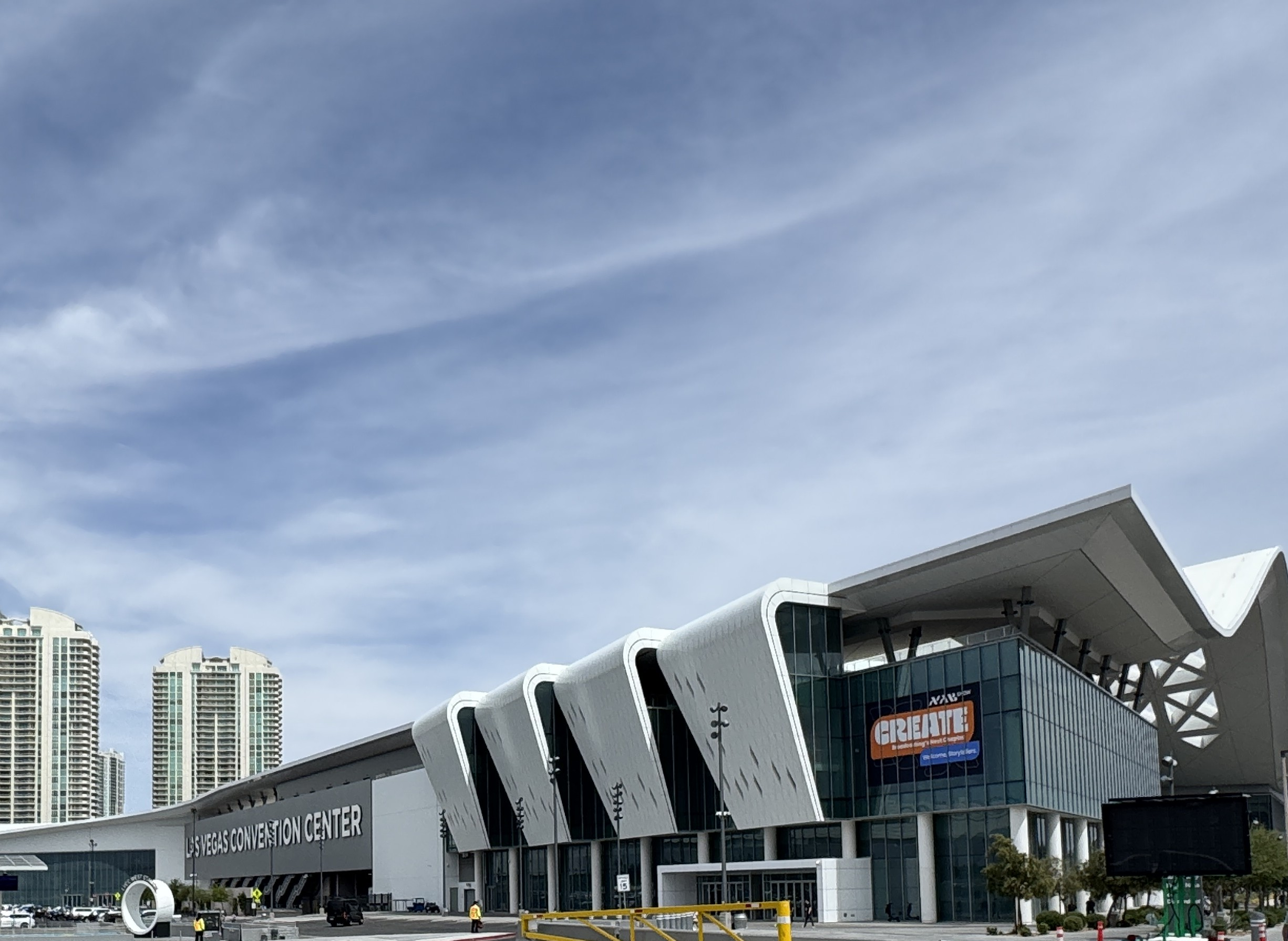
NAB Show Day 1: Ten interesting companies for Enterprise Video in West Hall
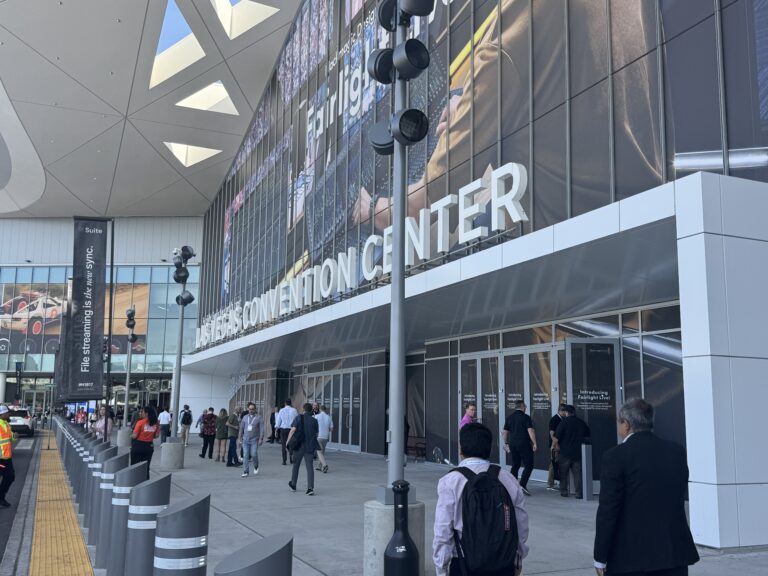
April 2026 | Las Vegas Convention Center
Day 1 on the NAB Show floor is a particular kind of sensory overload. The West Hall alone covers more square footage than most corporate campuses, and every booth is competing for attention with the same combination of giant screens, loud demos, and staff trained to flag you down from fifteen feet away.
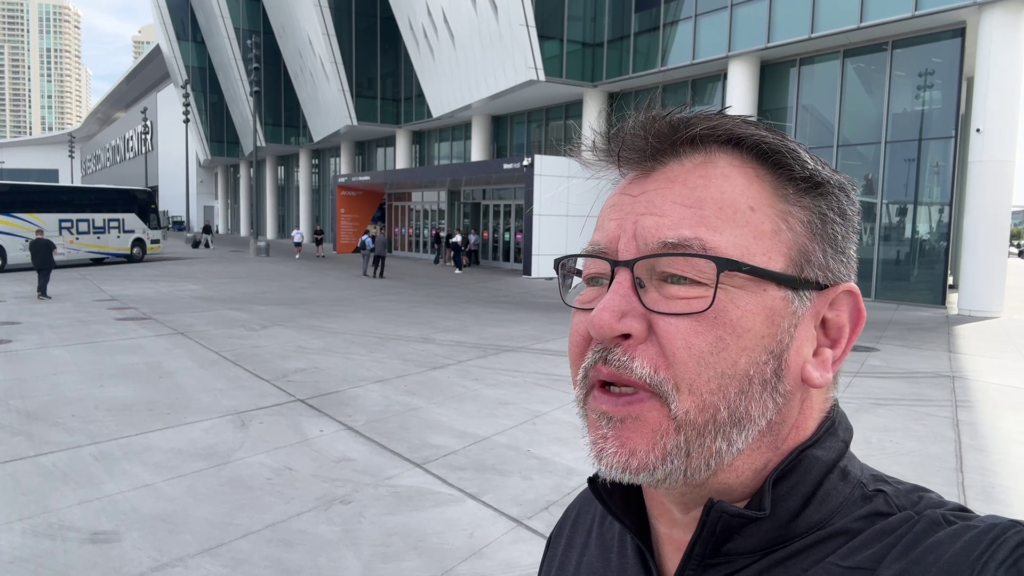
You gotta move swiftly and the trick is knowing what you are looking for before you walk in. I’m decent at planning and preparation, and I walk fast.
My lens, though, is not the broadcast engineer’s lens. I evaluate these technologies for mid-market enterprises, healthcare organizations, universities, and government agencies that produce copious amounts of video content without calling themselves media companies. That distinction matters when you read what follows.
NAB remains a broadcast-centric event. But beyond the broadcast vocabulary, many of these products solve problems that organizations with growing video operations will recognize: Content that is hard to find, workflows require too many manual steps, and their infrastructure was never designed for the volume of video being produced today.
Here is what I found.
OpenDrives – Storage That Follows Your Team
OpenDrives makes software-defined storage and data management for video-heavy organizations. Historically, OpenDrives sold both the hardware and software for storage solutions, but have in recent years switched to a software-only focus, similar to several other vendors.
OpenDrives’ NAB headline was Edge, a product that lets distributed teams pull data once from a central hub, cache it locally, and work at local network speeds without dealing with cloud latency or egress costs. Changes sync back to the source automatically. It connects to AWS, Google Cloud, and Azure, and is available now through their Atlas platform.
The practical problem it solves is one that any organization with teams in multiple locations knows well: People wasting time managing file transfers and sorting out version conflicts instead of doing the actual work.
OpenDrives also showed their Atlas platform version 2.11 and a Corporate Creative Solution tailored for corporate marketing teams and creative agencies, along with the IT teams supporting them, which is the most direct signal they are positioning beyond traditional broadcast customers.
VIDA – Cloud-Native Asset Management for Published Content
VIDA, part of Visual Data Media Services, a global provider of services to the M&E industry, is a cloud-native Digital Asset Management platform with a focus on published and distributed content. The platform offers advanced search, AI-driven tools for translation, subtitle creation, metadata enrichment, moderation, and automated tagging, with access through any browser.
VIDA was among 28 UK companies represented at NAB Show 2026 as part of the Great Britain and Northern Ireland presence across multiple exhibition halls. Their product is oriented toward organizations that need to manage content that has already been produced and published, such as libraries, archives, and distributed catalogs, rather than production workflows.
For an enterprise buyer managing large volumes of finished video assets across departments or channels, perhaps delivering content to internal or external “storefronts” or distribution platforms, remote access VIDA may represent a meaningful solution distinction.
Ortana – Connecting What You Already Have
Ortana makes Cubix, a media orchestration and workflow platform built around a large library of pre-built integrations. Their value proposition is that organizations should not have to choose a single vendor stack since Cubix connects whatever they already have.
Cubix Connect is deployable as a global enterprise service bus connecting a broad range of legacy technologies, or as tightly integrated micro-connections providing the technology glue to orchestrate and automate data, drawing on over 165 API integrations.
At NAB 2026, Ortana was also visible through a partnership announcement with Facilis Technology, where the Cubix Connect Widget enables remote access for administrators and power users to storage and user account management, workstation authorization, and server health reporting.
For enterprise buyers, the relevant capability is not the Facilis integration specifically – it is the broader pattern: Ortana as the connective layer between tools that do not natively talk to each other.
Telestream – Practical AI, Not AI Theater
Telestream is easily one of the most established names in media workflow automation. The Vantage platform handles ingest, processing, quality control, and delivery for some of the largest media operations in the world.
At NAB 2026, an exciting Vantage story was about what they are calling practical AI, meaning AI embedded into production pipelines rather than bolted on as a separate tool.
The five areas they expanded are all practical: captioning and translation across 128 languages, automated quality control that flags only the exceptions that need human review, speech-to-text that works on content still being ingested rather than waiting for a completed file, frame-level visual analysis that automatically detects objects, logos, and compliance issues, and content-aware media analysis that goes beyond technical specs to understand what is actually inside a file.
Two things worth noting for enterprise buyers: Customer content is never used to train shared models, which addresses a concern that comes up constantly in enterprise AI conversations, and the whole platform deploys on-premise, in the cloud, or hybrid, so it fits into whatever infrastructure an organization already has.
Telestream also announced expanded integration with Adobe Premiere, Adobe Media Encoder, and Frame.io, delivering a fully orchestrated creative-to-delivery pipeline. The result is no manual exports, no watch folders, and no disconnected handoffs.
For enterprise video teams using Adobe tools, this potentially closes a real gap.
Qibb – Low-Code Workflow Orchestration for Media
Qibb is a cloud-based low-code orchestration platform built specifically to target media workflow needs. It aims to be the glue layer between tools, connecting them to automate the handoffs, and providing visibility into what is happening across the pipeline without requiring a team of developers to maintain it.
Qibb connects tools, automates workflows, and controls media operations from ingest to playout across cloud, hybrid, and on-prem environments. It does not replace solutions like Dalet, Avid, or Mimir, but enables integration and automation so they function as a unified system.
The enterprise relevance here is direct: if your organization has accumulated multiple video tools over time that do not integrate cleanly with each other, qibb is worth understanding. Qibb is cloud-based solution with “agents” and “connectors” deployed on-premises for infrastructure integration, and also leverages a subscription model for licensing.
Norsk – Live Workflow Orchestration, Now With AI That Acts
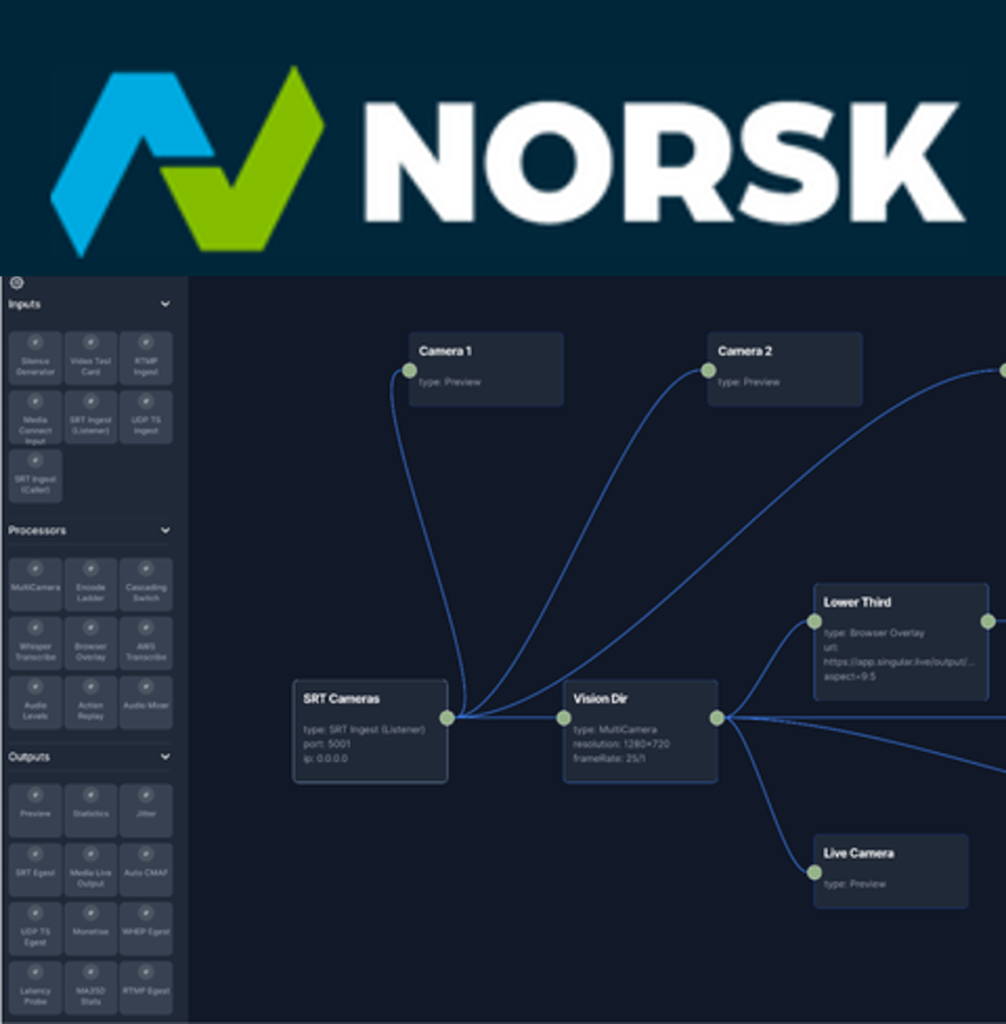
Norsk is a live video workflow engine that handles the complexity of managing live video pipelines at scale.
Their NAB announcements were the most technically dense of the day, but one worth noting for a non-broadcast audience was Norsk Reasoning, their AI layer. This is a multi-modal AI system natively integrated into the Norsk pipeline.
Operators describe detection objectives in natural language; a planning model structures those into a detection specification that a faster evaluation model executes against the live stream in real time. The system can autonomously switch camera sources, trigger recordings, fire webhooks, update graphics, and execute other functions with human override always available.
Norsk is primarily a live broadcast technology, but as enterprise organizations invest in live internal video for town halls, training sessions, event streaming, etc., the underlying challenges become relevant beyond the broadcast world.
Codemill – MAM, QC, and Live-to-VOD in One Stack

Codemill is a Swedish software company with two main product lines: Cantemo, a flexible media asset management platform, and Accurate.Video, a suite of tools for quality control, content preparation, and media review.
At NAB 2026, their booth focused on two themes.
The first was their QC Assistant, an AI-assisted quality control tool designed not just to flag issues, but to provide contextual recommendations based on your specific rules and historical decisions, reducing the time operators spend interpreting results.
The second was a live-to-VOD workflow (developed in partnership with Hiscale, their technology partner.) The capability allows teams to begin working with content – logging, editing, quality checking – while it is still being captured, rather than waiting for the file to be complete. For enterprise teams producing large-scale live events such as town halls, this compresses the gap between capture and usable content.
Codemill is a highly extensible and customizable platform that deploys primarily in hybrid or on-premise environments. For many enterprise organizations with matching requirements and capabilities, this distinction can be paramount to their IT operational & security policies.
Embrace – Integration and Workflow Orchestration
Embrace is a media-centric workflow orchestration and integration platform operating in similar territory to Ortana and qibb: Connecting media tools, automating handoffs, and providing a layer of control across complex production environments.
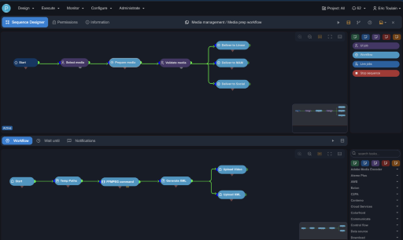
At NAB, Embrace demonstrated a practical agentic AI use case where a user issues a natural-language request, for instance “Package and distribute training videos A, B, and C for the corporate streaming platform”. Pulse-IT acts as the orchestration layer that triggers end-to-end search, compliance validation, and content packaging automatically.
The Embrace CPTO Eric Toulain framed their view that the value of AI comes when it is embedded into orchestrated workflows with visibility, control, and accountability, not as a standalone capability.
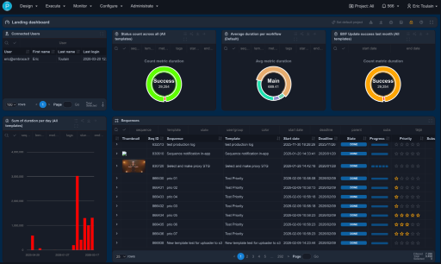
What distinguishes Embrace in the enterprise video market is a focus on the integration layer between media production systems and business systems. Bridging the gap between how media is produced and how it is managed operationally within a larger enterprise is key to organizations across the spectrum
Perfect Memory: DAM Built Around Meaning, Not Just Storage
Perfect Memory is a French company with a distinctive take on digital asset management. Where most DAMs start with storage and search, Perfect Memory starts with semantics, which is the idea that an asset’s value is determined by its relationship to business context, not just its metadata fields.
Their third-generation DAM stores assets and aims to “understand” them by connecting content to business data and context.
At NAB 2026, Perfect Memory announced that BCE had selected Perfect Memory as the metadata and asset management solution for its Media-as-a-Service offering.
For enterprise buyers evaluating DAM platforms, Perfect Memory may be worth a closer look if the primary problem is not just finding assets but understanding what they are actually worth to the business.
MASV: File Transfer That Disappears Into Your Workflow
MASV is a managed file transfer platform built for large media files. The reason it belongs in this list is not the transfer capability itself, it is the integration story. At NAB, MASV announced new integrations with Iconik, IBM Cloud Object Storage, and LucidLink Connect, and also demonstrated existing integrations with Amazon S3, Mimir, Frame.io, and Wasabi, while teasing upcoming integrations with TrueNAS, Orange Logic, Grass Valley, and GB Labs.
The design principle behind these integrations is clear: Moving large assets at scale has meant going outside of the core workflow and spinning up separate tools, managing manual handoffs, or even custom code just to get a file quickly from point A into the infrastructure.
MASV’s Mimir integration is particularly relevant to Varde clients: The two platforms work together to move content from field capture into a managed production environment automatically, with metadata intact.
Happy Hour Time: What Day 1 Told Me!
Ten companies, one somewhat consistent signal: The media technology infrastructure market is maturing in the direction of the enterprise buyer. Many vendors appear to be either expanding integrations, simplifying UX and integrations, and/or adding AI that requires no specialized expertise to operate, or both.
The more important observation is about sequencing. AI-powered search, automated tagging, and intelligent quality control only work if your content is organized, accessible, and consistently described in the first place.
Several conversations I had on the floor confirmed that organizations jumping straight to AI capabilities are often discovering this the hard way. The foundational work, i.e., knowing what you have, where it lives, and how to get to it, is still the prerequisite.
If anything covered here is relevant to a challenge your organization is working through, we are happy to talk through the specifics. That is what we do at Varde.