Field Report from the Fonn Group User Summit
The AI Shift vs. Enterprise Video

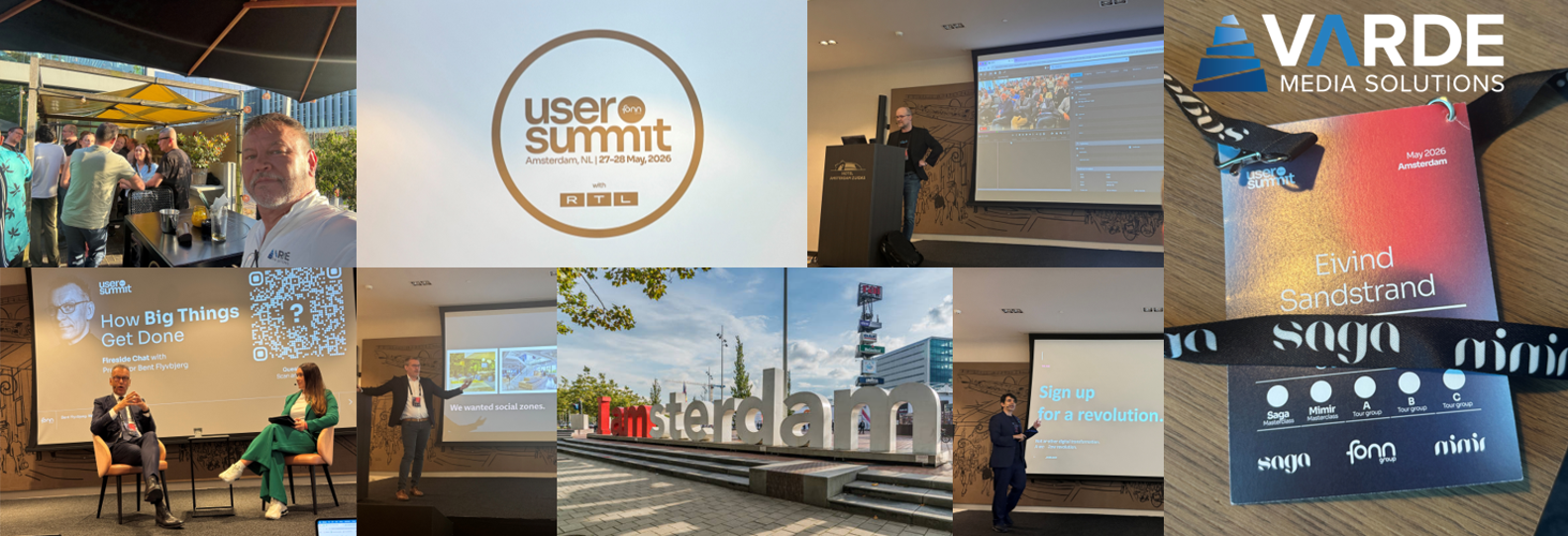
These days one must travel to find valuable information. The Fonn Group’s annual User Summit is a chance to escape the brain-numbing noise of the mega-expos. It is also a unique opportunity to listen and learn from some of the smartest people on the planet.
Fonn Group builds Mimir and Saga, the media asset management and newsroom platforms that run operations at broadcasters like NRK, RTL, TV 2, and TVNZ. Its annual user summit fills a room with the people who run those operations.
I was not one of them. Varde works on the other side of the market, with enterprises and institutions that produce far more video than they realize and manage almost none of it. The technology these media organizations have spent years and money implementing is the same one now arriving on enterprise desks, along with business transformation challenges of a vastly different nature.
And the summit opened with a question that every enterprise should be asking too.
The Question Put to The Room
Group’s CEO, Håvard Myklebust, opened the summit with a humorous example of “AI widowry,” candidly sharing how Steinar Søreide, Mimir’s CTO, was supposed to be doing something as mundane as taking a shower but lost all track of time as his wife started to worry that something had happened. It turned out he had just gone down a rabbit hole and was building new apps on top of Mimir’s new connector to Claude. In the shower.

As Myklebust told the audience, he himself had become a “Mimir developer” over the weekend, creating his own apps as well, despite not having written a line of code since Turbo Pascal in the 1990s.
The point is not the apps; it is that the barrier to building is collapsing. By connecting complex media technology to AI, the people who use these systems can now create their own tools and workflows, in minutes, without being programmers.
Myklebust put the challenge to the room. The digital transformation is now arriving for all of us, through AI. It puts creative power in the hands of customers and end users in a way the industry has not seen before. But what will happen if manufacturers like Fonn with Mimir and Saga choose to enable it and give people access?
Everyone in the room could understand that this is both a threat and an opportunity for the manufacturers themselves, to those whose business it is to build solutions on top of them, and to the traditional technology structures in between.
Will all customers become builders? Will Mimir and Saga and other tools become AI-enabling platforms? How does this impact the transformations of the future? He did not answer the question. He told the room to listen to the two days of sessions and draw their own conclusions.
AI is Destroying the Value of Video Creation

Doug Shapiro, one of the most respected media business analysts in the world, gave a clear read of where this is heading. His framing was that digitization made information computable, and AI now makes meaning computable. The cost of creating content is collapsing toward zero. AI already writes half of all online articles, and technology can produce future content at a fraction of today’s cost.
When making a video costs almost nothing, the act of making it stops being valuable.
But Shapiro’s second point matters more for enterprises. The consumers of your content never really rewarded you for the cost you incurred to produce it. They want content that has “meaning,” information that is relevant to them and available wherever they already are. Polish was a proxy for effort, and AI is making that effort cheap.
What people will still pay attention to is whether the content is useful, current, and theirs to trust. This is where the corporate stakes show up, and they are not a marketing problem alone.
For Marketing and Brand, the differentiator stops being how the video looks and becomes whether it carries something only your organization has. For HR and internal communications, it is whether employees can find the right version and believe it is the official one. For Compliance and Legal, it is whether you can prove what a piece of content is, where it came from, and that it has not been altered. The examples go on and on.
A content factory that enables and preserves authentication and provenance moves from a technical footnote to a strategic business requirement. When anyone can generate a convincing fake of your brand, your executives, or your training material, the ability to prove origin is not trivial. It is how you protect the meaning of your content, which is the only part AI cannot manufacture for you.
AI is not destroying the value of video. It is destroying the value of making it and moving that value to whoever can make their content relevant, accessible, and provably real.
Business Transformation Needs a Content Factory
Most enterprises do not set out to build a content operation. They set out to do something else and discover they need one to get there.
Some examples that by now should be familiar:
- A company decides its growth depends on reaching customers digitally, and that video will carry a large part of that.
- HR wants onboarding and training that can reach a distributed workforce.
- Legal and Compliance need defensible records of what was communicated, to whom, and when.
- Knowledge management wants to retain and leverage what experienced people know before they walk out the door.
- Internal communications needs employees to hear the same message, the right version, wherever they are.
- And so on
None of those are video projects. They are business goals, and most of them sit inside some larger transformation the company is already committed to. But each one quietly assumes the same thing underneath, that the organization can produce video, find it, trust it, govern it, and reuse it at scale.
That capability is the content factory. Without it, the goal stalls, no matter how good the intent or the budget behind it.

This is where the broadcasters are worth listening to, not as a template, but as a warning about scale. RTL’s transformation reached into culture, the newsroom layout, strategy, tooling, and even how they negotiate with vendors. TV 2 Norway set out to change a system and found they were changing the business. Their world is not the corporate or institutional one, but the shape of the problem is. A capability like this does not appear because someone signed a purchase order. It gets built, on purpose, across more of the organization than anyone expects at the start. The content factory is not the goal itself. It is what the goal requires.
Don’t Listen to Others. You Got This By Yourself!

Your situation is special. Your organization is different. The people who have done this before did not have your constraints, your culture, or your particularly difficult stakeholders. Better to work it out from first principles, in-house, your own way.
That instinct is exactly how these projects fail.
Professor Bent Flyvbjerg has studied large projects for decades, and his numbers are sobering. Around one in two hundred major transformation projects come in on time, on budget, and with the result they promised. One in five IT projects does not just miss the marks, it becomes a “black swan,” an overrun so large it can threaten the organization that started it. These are not rare bits of bad luck. They are the base rate.
His explanation is uncomfortable because it points inward. Projects fail when the people running them believe their case is unique. If you are convinced no one has faced your problem before, you will not look for what already works, and you will end up building something bespoke, slow, and fragile.
His advice runs the other way. Do not do bespoke. Do standard. Do modular. Start from what has been proven and adapt it, rather than inventing from scratch because you have decided you are the exception.
The rest of his prescription is just as plain. Think slow, then act fast, because the time to be careful is before you commit, not after. Get the best people in place before the project starts, not once it is already in trouble. And put someone in the room whose actual job is to stay paranoid about the risks, since optimism is not the same thing as a plan.
Flyvbjerg’s advice is practical. The Content Factory does not have to be built from scratch. The components exist, they have been proven in demanding environments, and the sensible path is to assemble vetted parts into a modular whole rather than custom-building the thing end to end: Standard over bespoke, proven over invented, modular so the organization can adapt later without tearing it down.
The Tools Are Ready. That’s Not The Hard Part, Though.
Hossein Sharif from As If Pictures, which has perhaps shepherded more newsroom transformation projects than anyone else, gave the session that stayed with me. He told a story from the early days of electric power, and it explains the whole problem.
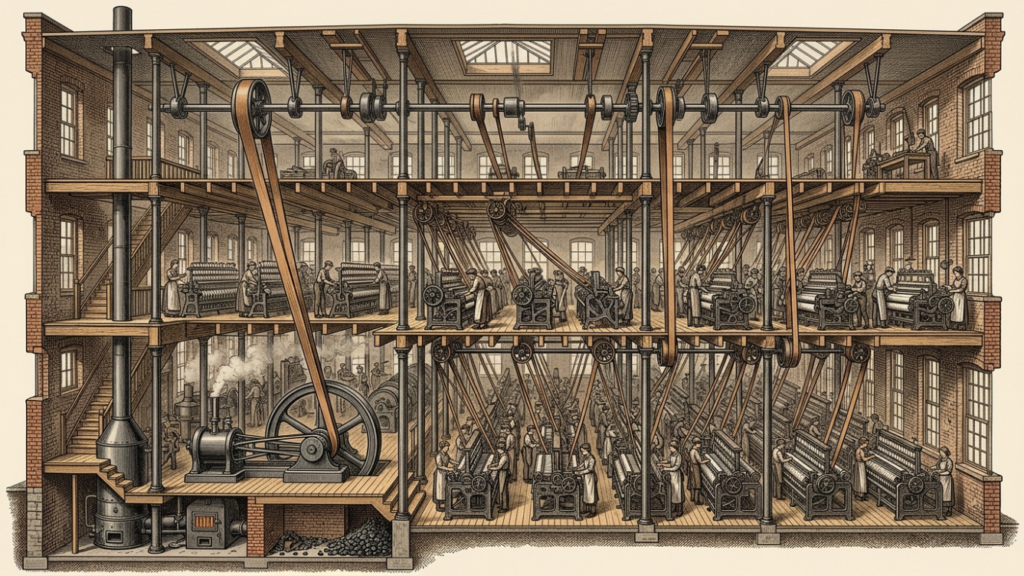
For most of the 1800s, a factory ran on one large steam engine. The steam engine sat in the basement and powered a system of rotating shafts and leather belts that ran the length of the building. Every tool and machine had to be placed where it could reach a belt, so the engine dictated the layout of the factory and the speed at which it moved. When electric motors arrived, the obvious move was to pull out the steam engine and bolt a big electric motor into the same spot, driving the same shafts and the same belts.
They did not gain a fraction of improvement.
Because the electric motor just drove the same shafts and belts at the same speed, in the same locations, making workers work at the exact same velocity as before.

Sharif pointed out that we keep making the same mistake. We buy the new engine and leave the belts and the floor plan where they were. We change the technology but not the workflow, we change the workflow but not the roles, the roles but not the way the work is measured. He was blunt about it: You cannot buy your way out of this.
New tools bolted onto old habits give you the old results with a bigger invoice.
I agree with Sharif’s perspective of taking a broad approach to the hardest parts – the workflows, metadata design, system design, roles, and responsibilities, etc. Which raises an obvious objection. If those items are the hard part, then surely the tools, at least, are sorted by now.
The product sessions made the technical progress impossible to argue with. Mimir and Saga now connect to AI directly, to the point where, as Myklebust showed, someone can build a working tool on top of them in an afternoon. Around them was a set of partners doing the same at the component level.
Embrace orchestrates workflows and AI agents. Twelve Labs reads video and generates usable metadata and descriptions from the footage itself. Highfield AI produces graphics automatically from templates. Everviz turns data into maps and charts on demand. Not long ago, each of those would have been a project, fraught with risks and costs. Now they are parts you assemble.
But assembly creates its own problem, and Sharif named it.
Once you have a dozen connected systems, who owns the glue between them? In most organizations, no one does. Tech owns the systems, HR owns the roster of who does what, and the content people own the content. The connections between them, where the actual workflow lives, belong to nobody. This is where things quietly fall apart and why the tools are not the hard part. When the technology was scarce and expensive, simply having it was an advantage. When everyone can get the same capable, AI-driven components, the advantage moves to whoever arranges them well around their own work. That means workflow, ownership, and the willingness to change how people operate, which is the part no vendor can hand you.
And If You Run Video Inside An Enterprise..?
Taking a step back from the broadcast setting, the picture is undeniably familiar.
The cost of making video is falling toward nothing, so the value has moved to the things that are harder to fake or replace, whether your content is relevant, whether people can find it, and whether they can trust where it came from.

Most of the goals that matter to an enterprise depend on them being able to do it at scale. For any form of video, that capability is a content factory, and it underpins each related goal of the business transformation.
The warning from broadcasters’ experience is useful. The work is broad, it touches more of the organization than anyone expects, and the projects that fail are usually the ones run by people who rush, do not think, and believe they are unique.
Which brings the two days back to the question Håvard Myklebust opened with. He asked whether platforms like Mimir and Saga would become the place where organizations put AI to work on their content, and what happens once that kind of power reaches ordinary users rather than specialists. It is both a threat and an opportunity, and for an enterprise it is both.
The opportunity is that you will soon no longer need scale, a large budget, or a development team to build real capability around your video. The threat is that the same is true for everyone else, so the tools alone will not set you apart.
The power Håvard Myklebust described is real and within reach, but it does not arrive on its own. The Content Factory doesn’t magically appear – it has to be built. The challenge isn’t met by simply inserting a product and labeling it a “solution”. But the reward, the value of the content you create and use to communicate internally and externally, can be greater than you imagined.